
Validation
The strongest current public claim is specific: a baryon-sourced coherence response can reproduce halo-like galaxy structure while remaining competitive on benchmark rotation-curve fits.
The result, computed live
One galaxy, three curves
This is the whole argument in one figure. The points are the measured rotation of NGC 3198. The grey dashed line is what visible matter alone predicts under Newtonian gravity: it peaks and falls away. The observed rotation does not fall: that gap is the dark-matter problem. The amber line is the coherence model, and it is not drawn by hand or fitted per galaxy: it is computed during this build by the coherence-time interpolation applied to the baryonic curve, with one universal coupling. Rebuild the site and it recomputes.
This page does not claim that every cosmology problem is solved or that particle dark matter has been eliminated. It presents the strongest scientist-facing result in a way that is specific, defensible, and tied to the current evidence ledger.
Validation stack
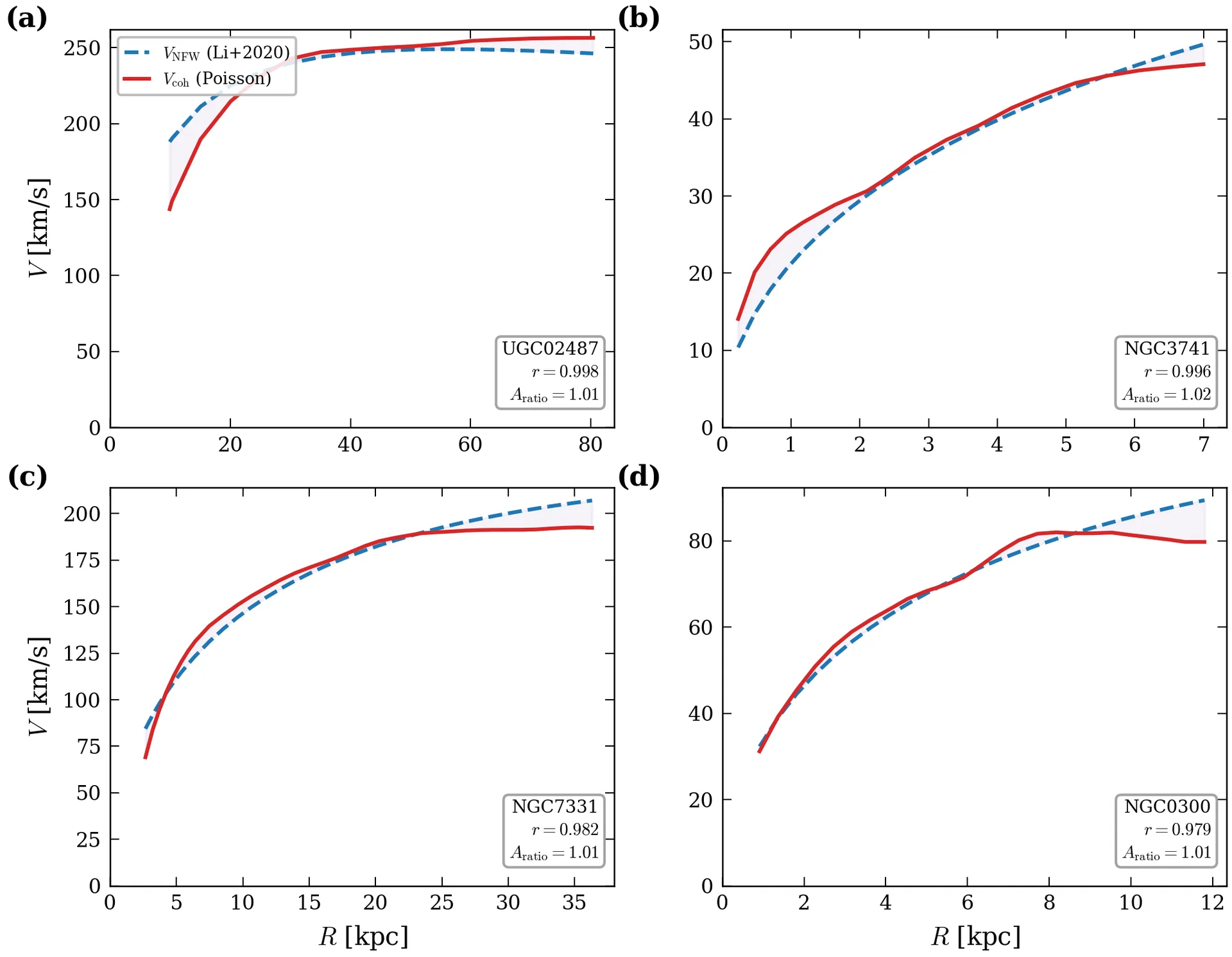
The public takeaway is modest and meaningful: halo-like galaxy behavior may be reproducible from a baryon-sourced coherence response, which weakens the claim that NFW-like profiles uniquely imply particle dark matter.
The validation story is built around the current weak-field and galaxy-limit bridge, benchmarked against SPARC and checked with hostile-slice and rerun audits. Final cosmology closure and microphysical source closure remain open.
What stays explicit
What the result says
The current galaxy result gives the research program a concrete observational bridge and a narrower public claim worth defending.
What the result does not say
It does not flatten theorem closure, observational fit quality, and external scientific consensus into one undifferentiated word like proof.
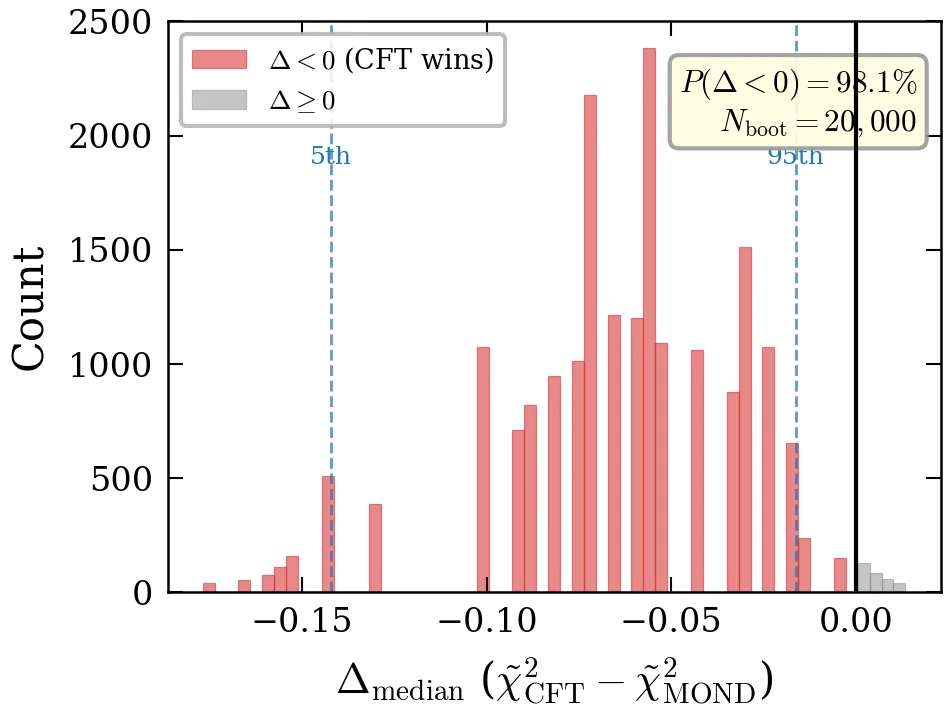
Why the bootstrap matters
The bootstrap figure tracks how internal derivation, evidence packets, and paper artifacts stay linked rather than drifting apart.
Check it yourself
The evidence is downloadable
The preprint behind this page, the preregistration that locks the next test, the open-source code, and the public datasets are all in the evidence library. If a number on this page has no artifact behind it, that is a bug.